

Dehydrated but Oily Skin: Why Your Face Feels Tight and Greasy
Yes, your skin can feel dehydrated even when your face looks oily or greasy. Oil and hydration are not the same thing. Your skin can have plenty of surface oil while still feeling tight, rough, uncomfortable, flaky, or irritated.
This can be confusing because the natural reaction to shine is often to cleanse more, exfoliate more, or reach for stronger oil-control products. But if the skin already feels tight or irritated, that approach may make it harder to restore comfort.
At Viviane Aires Skin Wellness in Philadelphia, the first step is understanding what is actually happening with the skin instead of treating every oily-looking face the same way.
If tightness, flaking, and lack of hydration are your main concerns, start with our Dry & Dehydrated Skin guide.
Can Oily Skin Really Be Dehydrated?
Yes. Oily skin and dehydrated skin can exist at the same time because oiliness describes sebum on the skin’s surface, while hydration relates to the water your skin holds.
That means your face may appear shiny but still feel uncomfortable.
Common signs include:
- Tightness after cleansing
- A greasy forehead or nose later in the day
- Rough or flaky areas
- Dull-looking skin underneath the shine
- Makeup separating in oily areas but catching on dry patches
- Increased sensitivity
- Skin that feels oily and dry at the same time
This is why simply adding another oil-control product does not always solve the problem.

Oily Skin vs Dehydrated Skin: What’s the Difference?
These terms describe different things.
| Oily Skin | Dehydrated Skin |
| Refers mainly to sebum production | Refers to insufficient hydration in the skin |
| Often appears shiny or greasy | May feel tight, rough, or uncomfortable |
| May be prone to clogged pores | May show flaking or fine surface lines |
| Can be a long-term skin tendency | Can change with routine, environment, or irritation |
| Can still become dehydrated | Can occur with oily, dry, or combination skin |
Dehydration is better understood as a temporary skin condition or state, while oily skin is often a more consistent skin characteristic.
You can therefore have oily, combination, acne-prone, or sensitive skin and still experience dehydration.
Why Does My Face Feel Tight After Washing but Oily Later?
If your skin feels tight immediately after cleansing but becomes oily later, your cleansing routine may be removing more than your skin comfortably tolerates.
Possible contributors include:
- Strong cleansers
- Washing too frequently
- Very hot water
- Scrubbing
- Exfoliating cleansers used too often
- Multiple acne products
- Strongly mattifying products
Your skin can still produce surface oil later even though it felt stripped immediately after washing.
Pay attention to how your face feels within the first several minutes after cleansing.
If it feels clean and comfortable, your routine may be working well.
If it feels stretched, itchy, burning, or unusually tight, your skin may need a gentler approach.
Clean skin does not need to feel squeaky or tight.
Signs Your Oily Skin May Also Be Dehydrated
Do not judge your skin by shine alone. Look at the full pattern.
You may notice:
- Tightness shortly after cleansing
- Oiliness returning quickly
- Rough patches on the cheeks
- Flaking around the nose or mouth
- Dullness despite visible shine
- Fine surface lines becoming more noticeable
- Foundation sitting unevenly
- Moisturizer or active products suddenly stinging
- Skin becoming more reactive than usual
If burning, redness, itching, or unusual sensitivity is becoming a bigger part of the problem, our Sensitive Skin guide may be more useful than simply adding more hydration.

What Causes Dehydrated but Oily Skin?
There is rarely one universal cause.
Over-Cleansing
Cleansing repeatedly because your face looks greasy can leave the skin increasingly uncomfortable.
The goal is to remove excess oil, sunscreen, makeup, sweat, and debris—not to remove every trace of natural oil.
Too Much Exfoliation
Using an acid cleanser, exfoliating toner, retinoid, scrub, peel, and other active products in the same routine can become too much for some skin.
Warning signs may include:
- Stinging
- Redness
- Tightness
- Flaking
- Increased sensitivity
- Roughness becoming worse
If your skin feels rough despite regular exfoliation, read our guide on why skin texture can stay rough after exfoliating before reaching for another acid or scrub.
You may also find our guide to maintaining a healthy skin barrier useful if irritation and barrier stress are becoming part of the problem.
Acne Treatments
Acne-focused products may be useful for breakouts and congestion, but some can also contribute to dryness or irritation.
This becomes more likely when several active ingredients are layered together.
If blackheads, clogged pores, or recurring breakouts are the bigger concern, explore our Acne & Breakouts guide.
Skipping Moisturizer Because Your Skin Is Oily
Many people avoid moisturizer because they assume it will automatically make oily skin greasier.
That is not always the case.
The American Academy of Dermatology notes that acne treatments such as benzoyl peroxide, salicylic acid, and retinoids can dry or irritate the skin, and an appropriate moisturizer may help. For acne-prone skin, it recommends looking for terms such as oil-free, non-comedogenic, or “won’t clog pores.”
That does not mean every oily skin type needs a rich cream. The formulation and texture should fit your skin.
Weather and Environment
Philadelphia weather can expose the skin to changing conditions throughout the year.
Cold outdoor temperatures, indoor heating, air conditioning, wind, and seasonal changes may all affect how comfortable the skin feels.
Your routine may therefore need to change with your skin instead of staying exactly the same year-round.
Does Dehydrated Skin Produce More Oil?
This is often oversimplified.
It is possible for skin to look oily while also feeling dry or dehydrated, but not every case of oiliness means the skin is “producing more oil because it is thirsty.”
Sebum production can also be influenced by:
- Genetics
- Hormonal changes
- Age
- Skin type
- Acne
- Products
- Environment
A more useful way to think about it is:
My skin may be oily and uncomfortable at the same time, so I need to address both concerns instead of aggressively drying out the oil.
How to Hydrate Oily Skin Without Making It Feel Heavy
1. Use a Gentle Cleanser
Your cleanser should remove excess oil, sunscreen, makeup, and daily buildup without leaving your face painfully tight.
If your skin feels stripped every time you wash it, stronger cleansing is unlikely to be the best solution.
2. Stop Chasing the “Squeaky Clean” Feeling
That extremely dry, tight feeling after cleansing is not the goal.
If you become oily later, repeatedly washing your face throughout the day can create an ongoing cycle of cleansing, tightness, and irritation.
3. Choose Moisturizer Based on Your Skin
Oily skin does not always require a heavy moisturizer.
Depending on your skin, a lightweight moisturizer, lotion, gel-cream, or non-comedogenic formula may feel more comfortable.
The useful question is not simply:
“Is my skin oily?”
Instead ask:
“What type of hydration supports my skin without making it feel heavy or congested?”
4. Simplify Your Active Ingredients
If several products in your routine exfoliate, brighten, control acne, reduce oil, and resurface the skin, some may be doing overlapping jobs.
A simpler routine makes it easier to identify what is helping and what may be causing irritation.
5. Watch How Your Skin Behaves
After cleansing, notice what happens.
Does your skin:
- Feel comfortable?
- Become tight immediately?
- Sting when moisturizer is applied?
- Become oily quickly?
- Develop dry patches later?
These patterns may tell you more than simply labeling your skin as “oily” or “dry.”
6. Do Not Treat Every Bump with More Exfoliation
Oily, dehydrated skin can also be congested.
But bumps can have different causes, including clogged pores, acne, irritation, or barrier stress.
This is where professional assessment can be more useful than repeatedly changing products.
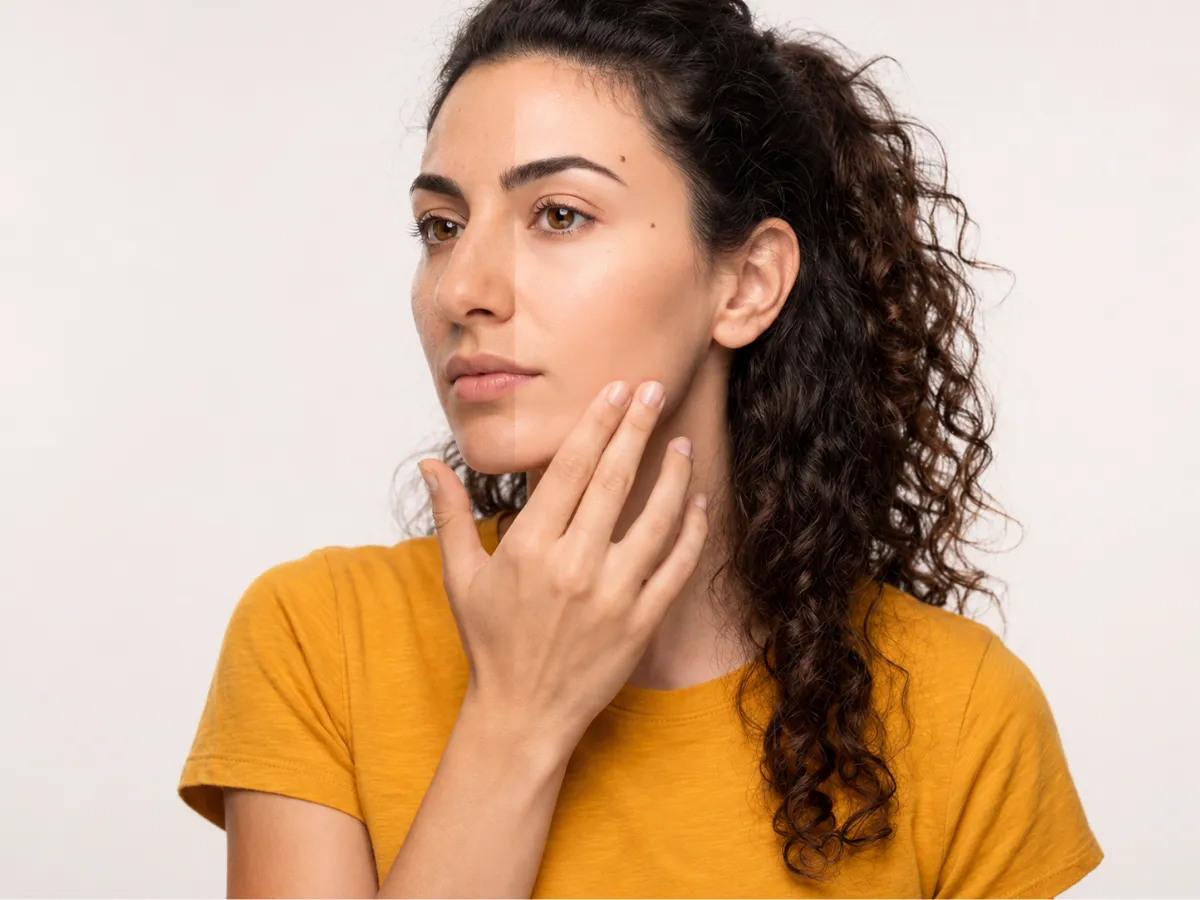
Dehydrated Oily Skin vs Combination Skin
These conditions are easy to confuse.
Combination skin generally describes different areas of the face behaving differently—for example, an oily forehead, nose, and chin with drier cheeks.
Dehydrated oily skin describes skin that produces visible oil while also showing symptoms such as tightness, roughness, flaking, or discomfort.
You can also have combination skin that becomes dehydrated.
Instead of forcing your entire face into one category, pay attention to individual areas and symptoms.
Should You Exfoliate Dehydrated Oily Skin?
It depends on the condition of your skin.
If your skin is oily, congested, and comfortable, appropriately selected exfoliation may be useful.
But if the skin is already:
- Burning
- Tight
- Flaky
- Red
- Stinging
- Suddenly sensitive
- Becoming rougher after exfoliation
adding more exfoliation may not be the right next step.
Hydration, barrier support, or simplifying the routine may need to come first.
What Type of Facial Is Best for Oily but Dehydrated Skin?
The best facial depends on why your skin is both oily and uncomfortable.
Someone with oily, congested skin may need a different approach from someone whose oiliness is accompanied by sensitivity, dryness, or over-exfoliation.
A professional assessment can consider:
- Hydration
- Oil distribution
- Clogged pores
- Breakouts
- Sensitivity
- Flaking
- Barrier condition
- Current active ingredients
- Homecare routine
At Viviane Aires Skin Wellness, a Customized Facial can be a useful starting point when you are unsure what your skin actually needs.
When dehydration is clearly one of the main concerns, you can also explore our Hydrating Facial in Philadelphia to understand the professional hydration options available.
The goal is not automatically choosing the strongest exfoliation or acne treatment. It is choosing care based on how the skin is behaving.
Oily and Dehydrated Skin Support in Philadelphia
Viviane Aires Skin Wellness is located near Rittenhouse Square in Center City Philadelphia.
255 S 17th St Suite 2407
Philadelphia, PA 19103
Viviane’s approach considers more than one skin-type label.
Hydration, sensitivity, congestion, pigmentation, acne history, current products, lifestyle, and the condition of the skin can all influence treatment recommendations.
If you are still unsure which professional treatment fits your concerns, you can also explore our facials in Philadelphia before booking.
When Should You See a Dermatologist?
Esthetic care can support cosmetic concerns and skincare guidance, but some symptoms require medical evaluation.
Consider speaking with a dermatologist if you have:
- Persistent or worsening rash
- Severe redness
- Significant itching
- Painful inflammation
- Cracking or bleeding
- Ongoing burning
- Severe or cystic acne
- Sudden unexplained skin changes
- Symptoms that continue despite simplifying your routine
An esthetician should not diagnose or treat medical skin disease.
Ready to Understand Why Your Skin Feels Oily and Tight?
If your face feels tight after cleansing but becomes greasy later, you may not need another strong cleanser, scrub, or mattifying product.
At Viviane Aires Skin Wellness, the goal is to understand whether dehydration, congestion, irritation, sensitivity, or several concerns are happening together before choosing the next step.